A spreadsheet tutorial is easy to follow while the answer sits beside it. Close the tab, change the numbers, and you find out which decisions you can actually make.
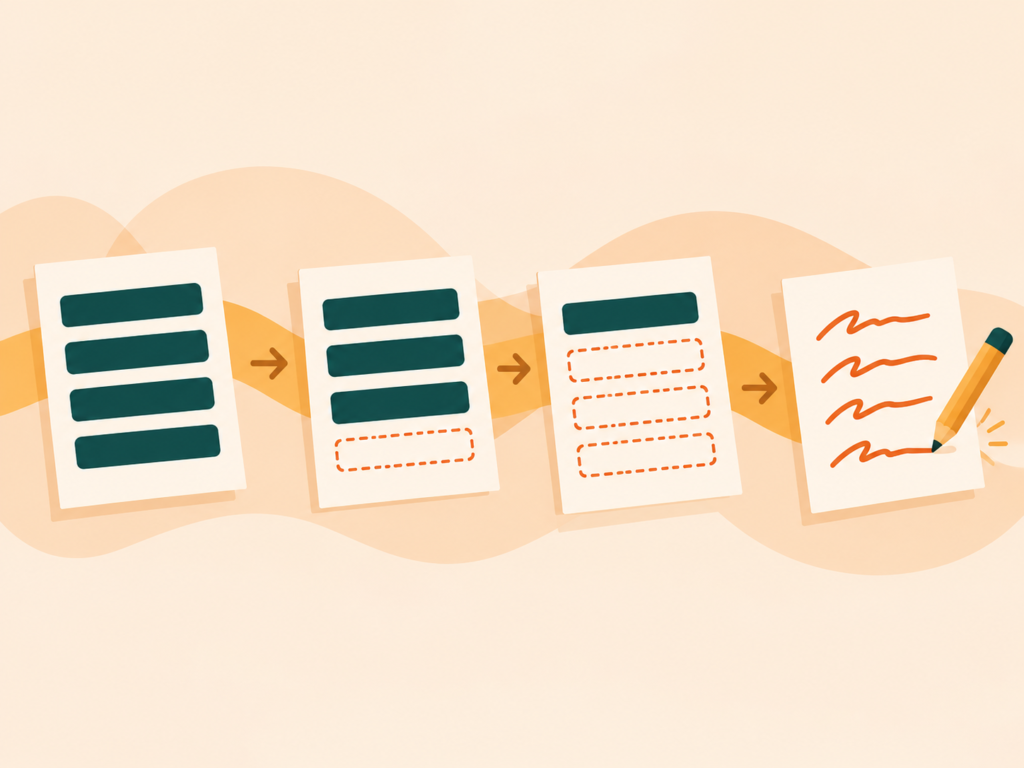
Worked example fading gives you a way to practise those decisions without starting from a blank page. Take a complete solution, hide one step and fill it in. As that becomes manageable, remove more of the solution. Eventually, try a new problem without the walkthrough.
The aim is to take over the reasoning a little at a time. Here is how that can work with a small spreadsheet task.
Start with an example you can trust
A worked example includes the problem, the steps to solve it and the reasons for those steps. An answer alone is not enough: you need to see how someone got there.
Choose a narrow task. “Learn data analysis” leaves you with too many decisions to practise at once. “Calculate an overall completion rate when groups have different sizes” gives you something you can finish and check.
Use a verified course example, a textbook solution or an explanation a knowledgeable colleague has checked. Keep the reasoning beside the relevant step. You should not have to hunt through another document to find out why an operation belongs there.
Our Learning Transfer Toolbox covers apps and environments for applying what you learn. Fading is something you can do within those practice sessions, though a sheet of paper is enough.
Try it with a completion rate
In this fictional example, two teams are checking documents against the same checklist. Each document counts once and belongs to only one team's batch. Both teams report on the same period.
| Team | Documents checked | Documents assigned |
|---|---|---|
| A | 18 | 20 |
| B | 8 | 10 |
What percentage of all assigned documents have been checked?
Here is the complete solution:
- Identify the unit being counted: documents, not teams.
- Add the checked documents: 18 + 8 = 26.
- Add the assigned documents: 20 + 10 = 30.
- Divide checked by assigned: 26 ÷ 30 ≈ 86.7%.
The tempting shortcut is to average the two team percentages. Team A has checked 90%; Team B, 80%. Their average is 85%. But that gives the teams equal weight even though one batch is twice the size of the other. The question asks about all the documents, so combine the counts first.
Explain that distinction before covering any steps. It is the decision you will need when the next table looks different.

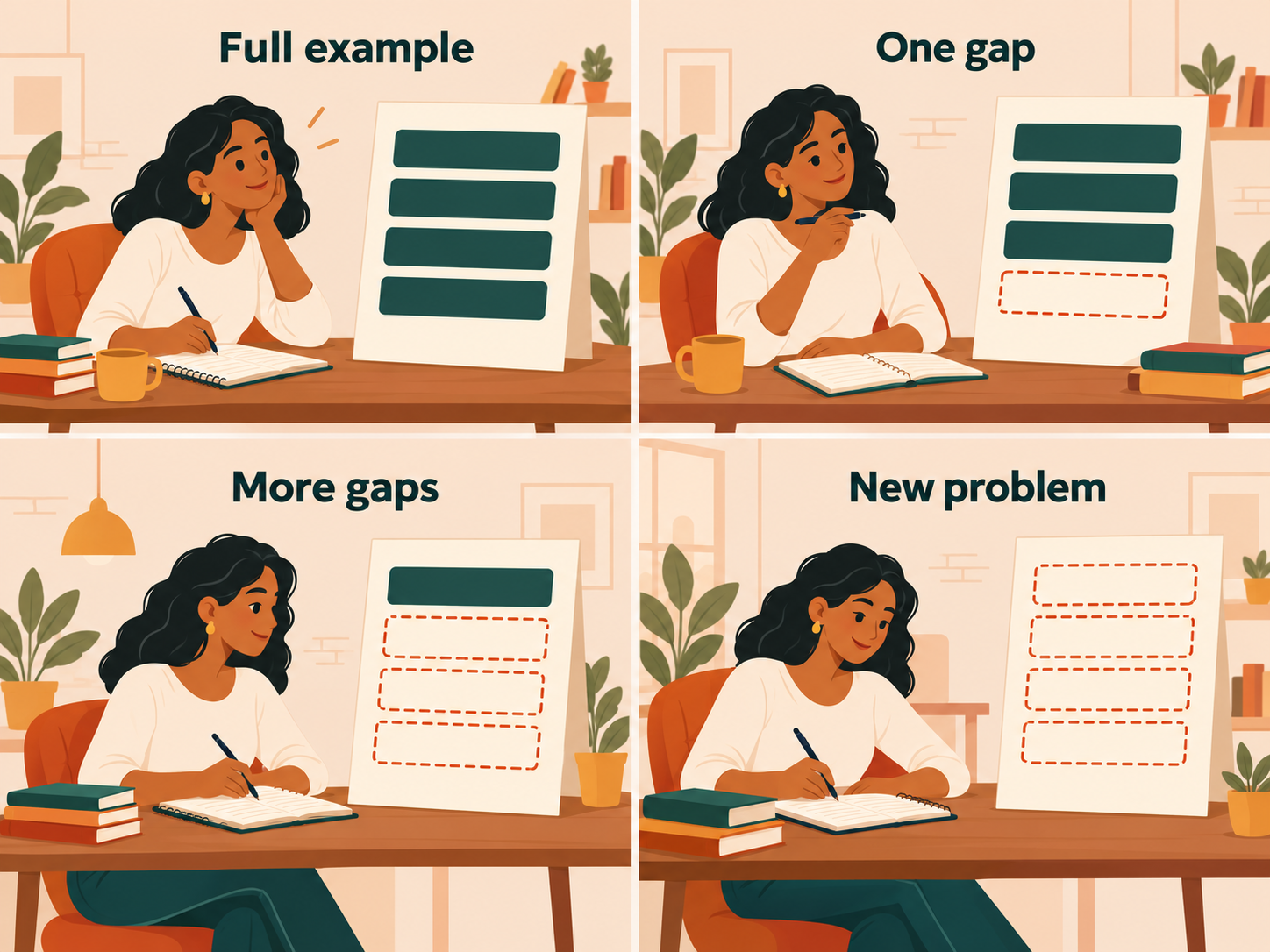
Cover the final calculation
In a new case, Team A has checked 12 of 15 documents; Team B has checked 9 of 10. Complete the missing step:
- The unit is documents, not teams.
- Checked documents: 12 + 9 = 21.
- Assigned documents: 15 + 10 = 25.
- Overall completion rate: ______.
Check your result against the answer key below. If you are unsure which total goes on top of the fraction, say the question aloud: “How many checked, out of how many assigned?”
The final calculation is a convenient place to begin in this example. For another skill, choose a step you are ready to attempt and leave the necessary supporting work visible.
Supply the totals as well
Use 14 of 20 documents checked in one team and 9 of 10 in the other. Keep just the first step supplied: the unit is documents, not teams. Work out the totals and the rate yourself.
Write a sentence explaining why you combined counts rather than averaged percentages. This is the self-explanation habit from our Feynman Technique guide, applied to one decision. “I added these numbers” describes what you did. “Each document should count equally even though the batch sizes differ” explains why.
Close the examples
Two training groups have completed 36 of 40 assigned exercises and 7 of 10 assigned exercises. Each exercise counts once. Calculate the completion rate across all assigned exercises and explain your method.
Keep a calculator or spreadsheet if arithmetic is not what you are trying to learn. The test here is whether you can choose the calculation without seeing a solution.
Answer check: The one-gap case is 84%. The more-gaps case is about 76.7%. The training-group case is 86%: 43 completed exercises out of 50 assigned.
Let mistakes tell you how much help to keep
A missing step can reveal different problems. Perhaps you have forgotten a definition. Perhaps the example skipped a decision you never understood. Or the new question may require a skill you have not studied yet. Find that point, restore the relevant explanation and try a similar case.

Getting the answer right without being able to explain it is a reason to stay with the current level of support. Change the numbers and try again. When you can supply both the step and its reason, remove more help. These are practical checks for this routine, not a validated scoring system.
After a few straightforward cases, change the question itself. Suppose you are asked for the average team completion rate, with each team weighted equally. Now averaging the percentages would be appropriate. Suppose some documents appear in both teams' counts. You would have to resolve the overlap before calculating an overall document rate. Knowing when the method needs to change matters as much as remembering its steps.
Keep any checklists, safety procedures and reference materials required in real work. Fading a learning exercise is no reason to discard safeguards.
Why combine examples with practice?
The research gives a reason to pair missing steps with explanations. In a 2003 paper, Robert Atkinson, Alexander Renkl and Mary Margaret Merrill tested fading alongside questions about the principles behind solution steps. Across two experiments, the combination improved performance on both similar and less similar problems relative to the comparison conditions. Earlier research had not found reliable benefits from fading alone on the more distant transfer tasks. Read the study abstract.
The US Institute of Education Sciences recommends alternating worked solutions with problems to solve, rating the evidence for that recommendation as moderate. The Australian Education Research Organisation's explicit-instruction guide, updated in September 2026, also advises removing example steps as learners become more proficient. IES practice guide, AERO guidance.
Studying examples alone has limits. A 2026 study of mathematical-equation learning found better test performance in conditions that included problem solving than in the worked-examples-only condition. It did not test the routine in this article. Zeitlhofer and Zumbach, 2026.
Those findings concern particular learning tasks. They do not prove that four passes will teach any workplace skill. The exercise above adapts the approach to something small enough to check; a harder procedure may need more examples, more guidance or an instructor.
If you use AI to prepare the exercises
Give the assistant an example you have already verified. Ask it to leave the problem and assumptions unchanged, remove selected solution steps and put the answer key separately. Compare the result with the original before using it.
Fresh AI-generated problems need an independent answer check. If you cannot judge an unfamiliar subject, use instructor-provided material or have someone qualified review it. Use fictional or public data for practice rather than uploading confidential workplace information.
Pick the procedure you keep looking up
You do not need to build a library of exercises. Take one procedure you have had to look up twice and make a version with a missing step. See whether you can fill it in and explain it. Add the next gap when you are ready; there is no deadline to reach the final stage in one sitting.
On a later day, try a similar problem before reopening the walkthrough. That is where spaced repetition fits: you return to the skill after a delay, with as much or as little help as you need.
If you get stuck, note the first decision you could not make. Start there next time, rather than replaying the whole tutorial.